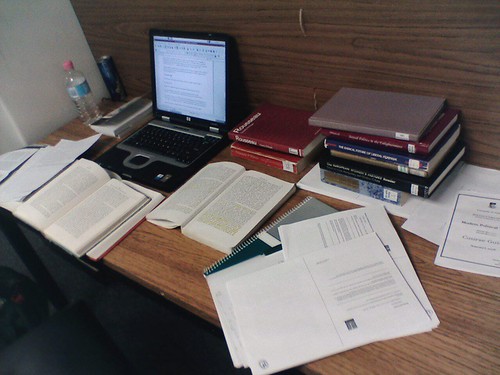
 Earlier this week, I turned in my first academic essay in over a decade. Back in September, I started a part time MA in British History, and I've been really enjoying my return to being a student so far. Now that the first module is done, it seems like a good time to reflect on how the experience is informing my library work.
1) I knew this in theory when I applied for the course, but full time work and part time study makes mastering time management a key core skill. Fortunately, I've spent the time since I was last in the classroom building up those skills and habits and routines, and a toolkit that includes reflection and re-evaluation which means I am in the habit of asking myself "is this tool / technique / habit still working for me", and adjusting my course as needed. Knowing myself and my work patterns has been a huge help as well. Now, here's hoping I can keep this up!
2) Talking of tools, Zotero. I may be just a little in love here. Not just the being able to keep track of citations, although *not* having to hand type pages of footnotes and bibliographies is, of course, great, but actually for keeping track of readings and notes along the way. Having everything rationally and flexibly grouped together, and being able to add notes and metadata and attach files, and have the whole thing sync to the cloud and work on every machine I use, regardless of OS ... I ended up with a folder for class readings, and one for my research essay, with an entry for every book / article / website used, which had the biblio, the pdf for articles and the book chapters I had ILL'd, and a note in which I had typed up my notes on the item, and also kept any quotes I might want to use (with page numbers, bien sur). It's building out of my old notes system, which was to keep a giant Word doc for each class, with all my notes and quotations and citations, out of which I could C&P ingredients for an essay, but far, far more flexible. As I am already into my next module, and there are a couple of books that overlap, I'm just adding a second note for "notes with focus X" and appreciating having my existing work easily to hand.
 Did I mention it integrates not only with Word, but with Open Office? And behaves on linux? And it's free? I would plan on using this for my next personal research project, and possibly for CPD stuff, as well as for academic essays. I met Zotero briefly during CPD23, but didn't really have a reason to dig deep enough into it to really see how it could help. The other options I considered for the module were Evernote and Google Drive, and while I'm still a Google girl in general, I'm happy with the choice I made. Zotero is a tool I'll be recommending to students in the future.
3) ILL librarian's are *awesome*. Although it's important to ask specifically for the notes when it's a book chapter with endnotes. (Neither part of this is news, but having first-hand user experience very much re-enforces it)
4) I have even more sympathy than I did before with the students who respond to being told something is available as an ebook, with a sigh and asking if there's any way of getting it in paper. Access to a text is better than no access, hands down, but format does matter, and so many of the academic ebook services are, frankly, a pain to use. You have to be online to use them. They're expecting you to be on a desktop or laptop, and may or may not handle the screen you're actually using, let alone an e-reader. They've disabled copying text, so you have to hand-type the quote despite the fact that it's right there, in a format that is inherently copyable. There's the log-in hoops to jump through, and getting timed out at annoying moments. The notes and the text may not be hyperlinked to each other, and flipping back and forth is fiddly. The load time for each page - and the fact it won't just go ahead and load the rest of the chapter in the background - made me want to grind my teeth, and then there was the particularly charming moment where one e-book platform decided that the time it took me to hand-copy a quote was evidence that I was done now and "check out" the ebook to another user, leaving me suddenly facing a "this book is being used by someone else - check back later" notice in the middle of a sentence. (That last one was the subject of some rude words, not least because if the book had been available in any other format than a £75 hardback with a 3-week lead time, I may well have purchased a copy for myself!)
5) Electronic access is wonderful. Even given all the above, I'd take e-access over none any day of the week, and the range and depth available is fantastic. E-journals particularly are just a thing of joy, and there are some types of (basically narrative) history where my personal preference is to buy an e-book and save my spine from carrying the hardback back and forth on the tube. Ditto institutional repositories and Ethos. Worlds of riches!
6) Research skills help - obvious, but true. Time spent mastering advanced searches, subject bibliography tools, and going on library introduction sessions was time well spent, but not time that you'll want to spend as the deadline approaches. I'm not sure how to get this message across to students who haven't experienced it yet, but I'm surer than ever that it's a message worth trying to send.
7) Related to the above, doing those induction sessions was a great reminder of how confusing and intimidating unfamiliar institutions can be, even if you're familiar with the type of institution, and how much of a difference a friendly face can make. The value of every interaction in creating an impression of your library, from the signage, to the website, to the front desk to the in-depth conversation. How much it helps when people act like human beings rather than automatons. That making explicit the expectations about the use a space or set of resources helps people meet them, but may also make them feel safer in the space, and thus more comfortable (and more able to learn).
8) Research as play to steal a phrase. This stuff is fun. Deadlines, not so much, but the process - even the writing and the editing - can be.
I won't find out how I've done in this essay for several weeks, but I really hope I passed, mostly because I'm really enjoying myself, and I want to carry on doing this!